
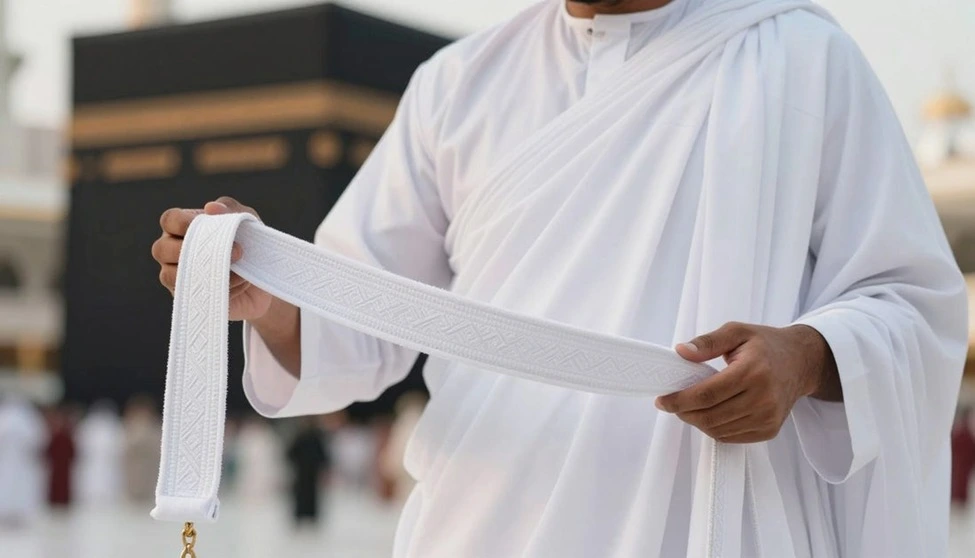
Before your Umrah flight leaves the United States, make sure you know what to wear, when to enter Ihram, and which actions to avoid. This guide explains the ihram rules for men and women in clear steps, helping first-time and returning pilgrims prepare for their journey with confidence.
From the Miqat boundary to the final hair trim, you’ll learn the essential requirements, common mistakes, and practical preparations for Umrah. My Umrah Packages helps US pilgrims plan their travel while understanding the religious steps they need to prepare for before departure.
What Is Ihram, and What Are the Main Rules for Men and Women?
Ihram is the sacred state a Muslim enters before performing Umrah or Hajj. It begins with the intention to perform the pilgrimage, accompanied by the prescribed rites, and brings specific restrictions that remain in effect until the pilgrim completes the relevant rituals.
The ihram rules for men and women share several requirements, including avoiding fragrance after entering Ihram, refraining from cutting hair or nails, and maintaining respectful behavior. Clothing requirements differ: men wear two prescribed pieces of cloth, while women wear ordinary modest Islamic clothing.
The Meaning and Significance of Ihram
The meaning of Ihram goes beyond clothing. It represents devotion, humility, and obedience to Allah. Pilgrims leave behind visible signs of wealth and status and focus on worship.
The significance of Ihram is also reflected in its restrictions. These rules encourage patience, self-control, and respect for the sacred journey.
When Do Ihram Restrictions Begin?
Ihram restrictions begin when you enter the sacred state through intention for Umrah or Hajj, not simply when you put on the garments. You may prepare and change into the clothing before reaching the Miqat.
Once you make your intention and begin the Talbiyah, observe the applicable restrictions until you complete the required rites and exit Ihram.
When and Where to Enter Ihram: Understanding the Miqat
The Miqat is a designated boundary that pilgrims intending to perform Hajj or Umrah must not cross without entering Ihram. The correct Miqat depends on your route, departure point, and travel arrangements.
For pilgrims flying from New York, Houston, Chicago, Dallas, or Los Angeles, planning ahead is essential.
| Miqat Point | Also Known As | Who Crosses It | Typical US Route |
| Dhul Hulayfah | Abyar Ali | Pilgrims departing from Madinah | Common for US flights routed Madinah first |
| Al-Juhfah | Rabigh | Pilgrims arriving from Syria, Egypt, or by sea near Rabigh | Rarely used by US flyers directly |
| Qarn al-Manazil | As-Sail al-Kabir | Pilgrims arriving from Najd, UAE, or the east | Not typical for US routings |
| Yalamlam | Al-Sa’diyah | Pilgrims arriving from Yemen or by air over that path | Some US flights approaching from the south |
| Dhat Irq | — | Pilgrims arriving from Iraq or the northeast | Not typical for US routings |
| Jeddah Airport (by air) | King Abdulaziz Int’l | Most pilgrims flying directly into Jeddah | Most common — put Ihram on before landing |
How to Enter Ihram Before Crossing Miqat
If your flight goes directly to Jeddah, change into your Ihram clothing before boarding or during the flight, then make your intention and begin the Talbiyah before crossing the applicable Miqat. Airline announcements may help, but do not rely on them as your only warning.
If you arrive in Madinah first, you generally enter Ihram at Dhul Hulayfah when leaving for Makkah to perform Umrah. Confirm your route with a knowledgeable guide if your itinerary includes connections or an unusual approach to the Miqat.
Ihram Rules for Men: The Two-Sheet Rule
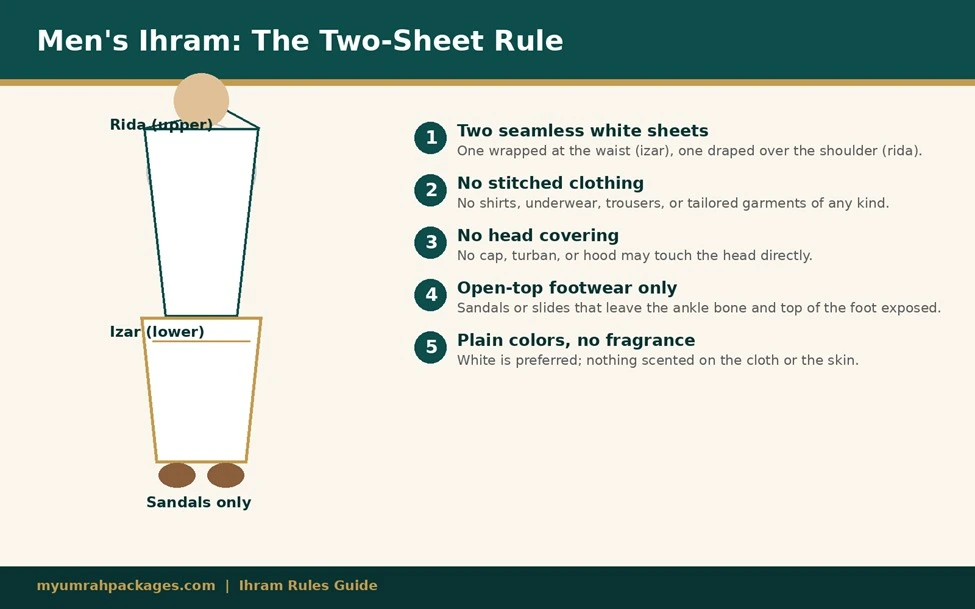
The ihram rules for men require a man to avoid ordinary tailored clothing while in the sacred state. The traditional garments are two simple pieces of cloth called the Izar and Rida.
How to Wear Ihram for Men Step by Step
- Izar: Wrap the lower cloth securely around the waist, covering the required area.
- Rida: Drape the upper cloth over the shoulders and torso.
- Footwear: Choose suitable sandals that meet the applicable Ihram rules; ask a qualified scholar about specific shoe designs.
- Head: Avoid covering the head with a fitted covering such as a cap or hat.
- Accessories: Belts, watches, eyeglasses, and bags are generally permitted.
White is a common and recommended choice, but the key requirement is following the prescribed clothing rules rather than treating every detail of the garment as a separate prohibition.
Can Men Wear Underwear in Ihram?
Men should not wear ordinary underwear while in Ihram because it is a fitted, tailored garment. A secure Ihram belt or pouch may be used to help keep the lower cloth in place.
What Footwear Is Permitted for Men?
Footwear rulings can depend on the type of shoe and the scholarly interpretation followed. Traditional guidance for men specifies footwear that leaves the ankles and certain parts of the feet exposed. When in doubt, choose simple Ihram sandals and confirm the details with a qualified scholar.
Ihram Rules for Women: More Flexibility Than Most Expect
Women do not need a special two-piece Ihram uniform. Their clothing should meet Islamic requirements for modesty and coverage, and ordinary loose-fitting garments are generally suitable.

What Should Women Wear During Ihram?
Women’s modest clothing for Umrah should be loose, opaque, comfortable, and suitable for worship. Women may wear an abaya, a long dress, or other modest clothing in an appropriate color.
Hair and neck should remain covered according to Islamic dress requirements. Women do not have to wear white, and ordinary stitched garments are permitted.
Can Women Wear Stitched Clothes in Ihram?
Yes. Women may wear stitched clothes in Ihram, including abayas, dresses, trousers, and other modest garments. The prohibition against ordinary tailored clothing applies to men in Ihram, not women.
Can Women Cover Their Faces During Ihram?
Women in Ihram should avoid wearing a fitted niqab and gloves according to the commonly taught rules. Guidance on covering the face when unrelated men are present differs in its details among scholars; some permit a loose covering that does not function as a fitted niqab. Follow the scholarly guidance you normally rely on.
Men vs. Women: Ihram Rules Side by Side
The main difference in Ihram clothing is that men wear two prescribed pieces, while women wear their normal modest clothing. Several restrictions apply to both.
| Rule | Men | Women |
| Garment type | Two unstitched white sheets (izar and rida) | Normal loose, modest daily clothing — no special uniform |
| Stitched clothing | Not allowed at all | Allowed and expected |
| Head covering | Not allowed — head stays bare | Required — hair and neck stay covered with a hijab |
| Face covering | N/A | Not allowed to touch the face directly (no niqab) |
| Hand covering | N/A | Gloves are not allowed |
| Footwear | Sandals exposing the ankle and top of the foot | Any closed or open shoe is fine |
| Color | White is strongly preferred | Any plain, non-flashy color is acceptable |
| Fragrance | Not allowed once Ihram begins | Not allowed once Ihram begins |
| Hair and nails | No cutting or trimming until Umrah ends | No cutting or trimming until Umrah ends |
These guidelines summarize common rulings. Some details vary by school of Islamic law, so ask a qualified scholar about circumstances that are unclear.
Step-by-Step: How to Enter the State of Ihram
The process of entering Ihram is straightforward when you prepare in advance. These steps cover purification, clothing, intention, and the Talbiyah.
Step 1: Complete Personal Grooming
Trim your nails and remove unwanted body hair before entering Ihram, if needed. Take ghusl before Ihram when possible; if a full ritual bath is not possible, perform the appropriate purification according to your circumstances.
Step 2: Put on Your Ihram Clothing
Men should wear the Izar and Rida, while women should wear clean, modest clothing and a hijab. Fragrance may be applied before entering Ihram, but avoid applying it after the sacred state begins.
Step 3: Pray Two Rak’ahs if Appropriate
Two voluntary rak’ahs may be offered when appropriate, but they are not a universal condition for entering Ihram. Avoid praying at prohibited times, and do not delay your intention past the Miqat to perform this prayer.
Step 4: Make the Niyyah for Umrah
Make the intention in your heart to perform Umrah. Saying the intention aloud is practiced by some pilgrims, but the essential point is the sincere intention to begin the pilgrimage.
Step 5: Recite the Talbiyah for Umrah
Begin saying:
Labbayk Allahumma labbayk. Labbayk la shareeka laka labbayk. Innal-hamda wan-ni’mata laka wal-mulk. La shareeka lak.
This means, in essence, that you answer Allah’s call, acknowledging that all praise, blessings, and sovereignty belong to Him.
Step 6: Follow the Rules Until You Exit Ihram
After entering Ihram, avoid prohibited actions and maintain patience, respectful speech, and focus on worship. The Sunnah of Ihram includes preparing properly and reciting the Talbiyah as prescribed.
Ihram Restrictions: Things Forbidden in Ihram
The main Ihram restrictions protect the sacred nature of Hajj and Umrah. Some rules apply to all pilgrims, while others are specific to men or women.
Restrictions That Apply to Men and Women
After entering Ihram, pilgrims must avoid the following:
- Applying perfume or fragranced products to the body.
- Cutting or trimming hair and nails.
- Sexual relations and sexual activity.
- Hunting land animals or assisting in hunting.
- Arguments, obscene speech, and sinful conduct.
The Quran states in Surah Al-Baqarah 2:197 that pilgrims should avoid sexual misconduct, wrongdoing, and disputes during Hajj. This guidance also reflects the respectful conduct expected throughout pilgrimage.
Additional Restrictions for Men
Men must avoid ordinary tailored garments, such as shirts, trousers, and underwear, while in Ihram. They must also avoid fitted head coverings.
Additional Restrictions for Women
Women should avoid fitted niqabs and gloves while in Ihram under commonly taught rulings. They should continue observing modest dress requirements while following the guidance applicable to their school of thought.
What If You Accidentally Break an Ihram Rule?
An accidental mistake does not automatically have the same consequences as a deliberate violation. The ruling depends on the action, the circumstances, and the scholarly interpretation being followed.
What Happens If You Break Ihram Rules?
If you use a scented product by mistake, wear a prohibited item unknowingly, or trim hair unintentionally, stop the action once you realize the mistake. Ask a qualified scholar whether any compensation is required rather than assuming every violation has the same penalty.
Fidyah for Breaking Ihram Rules
For certain violations, fidyah may be required. Depending on the specific ruling, compensation may involve fasting, feeding people in need, or an animal sacrifice. These options are not interchangeable in every situation, and more serious violations can carry different consequences.
If you are unsure, contact a qualified scholar or your Umrah group leader promptly. Accurate advice is especially important when a violation may affect the validity or completion of your rites.
Common Ihram Mistakes First-Time US Pilgrims Make
Pilgrims traveling from the United States often prepare for a long flight but overlook small details that matter once Ihram begins.
Avoid these common mistakes:
- Applying scented deodorant, lotion, or wipes after entering Ihram.
- Waiting until after crossing the Miqat to make the intention.
- Wearing ordinary tailored clothing while in Ihram as a man.
- Assuming women must wear white or a special Ihram uniform.
- Trimming nails or removing hair after entering the sacred state.
- Assuming every shoe design meets men’s footwear requirements.
- Packing only one set of Ihram cloth when a spare would be useful.
An Umrah preparation guide should include religious preparation, personal items, flight details, and a plan for reaching the Miqat at the correct time.
Ihram Do’s and Don’ts at a Glance

Ihram Packing Checklist for US Pilgrims
Pack your essentials before leaving home. Preparing in advance helps you avoid rushed shopping or confusion during airport transfers.
| Item | For Men | For Women |
| Ihram garments | 2–3 sets of seamless white sheets (pack extras — cloth shifts and stains) | N/A — wear your own modest, loose outfit |
| Footwear | Open sandals with a plastic bag to carry them during Tawaf | Comfortable closed walking shoes |
| Head/hair covering | None — keep an umbrella instead for sun protection | 2–3 plain hijabs or scarves |
| Unscented toiletries | Fragrance-free soap, unscented wipes | Fragrance-free soap, unscented wipes |
| Ihram belt / pins | A cloth belt or small safety pins to secure the izar | N/A |
| Extra layer | A spare white sheet for cooler nights | A light shawl for air-conditioned areas |
Choose products carefully and check fragrance labels. Keep Ihram clothing and essential toiletries in your carry-on luggage if practical.
Before You Fly: A Few Things to Sort Out First
Understanding the ihram rules for men and women is one part of preparing for Umrah. Make sure your travel documents, accommodation, transport, and flight itinerary are also in order before departure.
My Umrah Packages helps pilgrims traveling from the United States plan their Umrah arrangements. Review our Umrah visa guidance and available Umrah packages before your trip. Confirm the details of your route so you know when and where to enter Ihram.
When Does Ihram End?
For Umrah, Ihram ends after completing the required rites and performing the prescribed hair-cutting ritual. For Hajj, the process differs according to the type of pilgrimage and the stages of completion.
When Does Ihram End After Umrah?
The main steps are:
- Complete Tawaf around the Kaaba.
- Perform Sa’i between Safa and Marwa.
- Complete shaving or trimming hair after Umrah.
Men generally shave their heads or trim their hair, while women trim a small amount from the ends of their hair. Once the required rites are completed and the hair-cutting requirement is fulfilled, the pilgrim exits Ihram.
For Hajj, the timing of release from Ihram depends on the rites performed and the type of Hajj. Follow reliable scholarly guidance for your particular situation.
Final Thought
Learning the ihram rules for men and women before leaving home helps you prepare your clothing, understand the Miqat, and avoid common mistakes. Focus on the intention, the required rites, and the restrictions that apply throughout your pilgrimage.
With preparation and reliable religious guidance, you can approach Umrah with greater confidence and keep your attention on worship. My Umrah Packages can help with travel arrangements so you can prepare for your sacred journey.
Frequently Asked Questions About Ihram Rules
Can women wear Ihram of any color?
Yes. Women may wear modest clothing in different colors. White is not compulsory for women.
Is it okay to wear a watch or glasses in Ihram?
Yes. Watches and eyeglasses are generally permitted.
Do I need to remove my wedding ring during Ihram?
No. Wearing a wedding ring is generally permitted, provided it does not involve another prohibited action.
Can you use deodorant in Ihram?
Unscented deodorant is generally permitted. Avoid fragranced products after entering Ihram.
Can you shower while in Ihram?
Yes. Showering is permitted. Take care to avoid fragranced products and unnecessary hair removal.
Can you cut your nails in Ihram?
No. Nail trimming is prohibited during Ihram, subject to specific exceptions and scholarly rulings.
Can you cut your hair in Ihram?
No. Avoid cutting or removing hair until you reach the appropriate stage for exiting Ihram.
Can men wear underwear in Ihram?
No. Men should avoid ordinary underwear while in Ihram because it is a tailored garment.
Can women wear stitched clothes in Ihram?
Yes. Women may wear stitched clothing, including abayas and dresses, provided the clothing meets modesty requirements.
Can women cover their faces during Ihram?
Women should avoid a fitted niqab during Ihram under commonly taught rulings. Details about loose face coverings vary among scholars.
What happens if you break Ihram rules?
The consequences depend on the violation and circumstances. Some violations may require compensation, so ask a qualified scholar for guidance.
Do children need to observe Ihram rules?
Children performing pilgrimage should be guided according to their age and ability. The details of obligations and penalties differ from those for adults.


